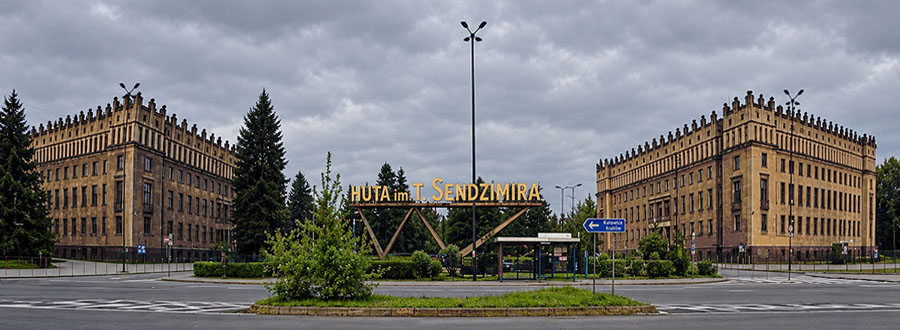
Secrets
of the eastern outskirts of Kraków
Few
accidental visitors ever reach the area of the former village of
Mogiła – once absorbed by the gigantic, concrete lungs of Nowa
Huta. There, where reinforced concrete blocks collide with the
boundless fields of cabbage and corn, and the Vistula flows lazily
between grass-covered embankments, the earth hides a dark secret.
Beneath layers of silt and ash stretches a dense network of
corridors remembering Austro-Hungarian times. It was in these
forgotten ammunition depots and underground casemates of the former
Kraków Fortress that laboratories were created, whose existence is
known only to a handful of insiders. The secret is guarded by nature
itself, which carefully camouflages entire complexes. The surroundings distract attention, but
with great effort an attentive eye can read much more than
meets the eye at first glance.
Hidden
entrances: Between two roads
The
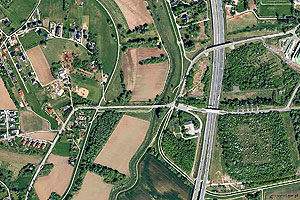
entrance to the main research complex itself is a masterpiece of
camouflage. It is a former two-lane ramp to the weapon warehouses, today
almost completely consumed by wild vegetation. On one
side it is protected by a high escarpment overgrown with dense lilac and
thorny hawthorn. On the other – a massive, concrete structure
from over a century ago, remembering the times of the imperial and royal army.
In a narrow strip of greenery, squeezed between two parallel
roads, beneath a thick layer of turf and ivy, heavy,
armored doors are hidden. No one walks here. No one asks questions.
The
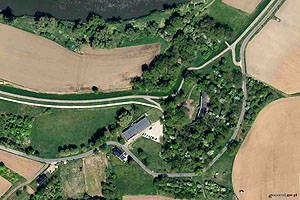
second laboratory, about three kilometers away, was arranged in an old
fort right on the bank of the Vistula. From the land side, the building has been
completely absorbed by nature – on its brick roof
a mature, dense forest has already grown. However, from the river side,
massive walls and narrow embrasures still loom, from which
a century ago Austro-Hungarian soldiers observed the foreground. Today,
something much older peers from these same dark openings. And
much more dangerous.
What
the dark dungeons hide
The underground
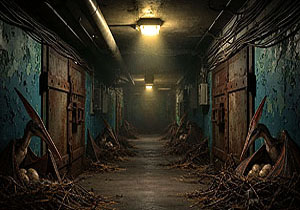
halls are wrapped in dense semi-darkness, saturated with overwhelming
moisture. The walls are covered with salt efflorescence and mold, and from
cracking vault arches water constantly drips, collecting
on the stone floor in murky, glistening puddles.
The air tastes of a specific mixture of cold earth, ozone and
harsh, chemical disinfectants.
In
these harsh conditions, far from the world, day and night
an elite team of Polish and invited Ukrainian specialists works.
Molecular biologists, geneticists from Kyiv,
Kraków paleontologists, biomedical engineers and military
weapons experts share a common fate in the shadow of the former
monarchy. And deep behind reinforced, hermetic gates,
here and there a deep, guttural wailing carries – these are
the dwarf tyrannosaurs.
The reason
for reactivating these Austrian dungeons is dark and ruthless. In
the face of growing threat from Russia, which has
completely absorbed Belarus, Poland faced the vision of
a new form of hybrid and armored warfare. To protect the facility key to
defense – the industrial combine – and avoid a repeat of history,
in a state of highest national necessity a bioengineering project was launched
based on the DNA of the ancient rulers of the Earth.
The main
line of defense consists of modified, dwarf tyrannosaurs.
They reach from 2.5 to 3 meters in height and weigh about 300
kilograms – they have been perfectly optimized for combat in densely
built-up areas, on narrow housing estate streets and in industrial
corridors. Ukrainian scientists, bringing invaluable experience
from urban combat, helped create an extremely aggressive species
against foreign technology, capable of independent reproduction in
underground halls beneath the combine and of persistent
combat readiness.
Fuel
for the defenders: Cabbage and corn
The greatest
logistical success of the project turned out to be feeding the beasts.
The creatures are fed exclusively on raw materials from the surrounding,
Nowa Huta fields of cabbage and corn, which reduces transport and the risk of
discovery to zero.
The crops
are given in the form of a thick, fermented feed enriched with
synthetic nitrogen and sulfur compounds. This mixture rapidly
builds muscle mass, but also has an unusual side effect –
it causes gigantic production of intestinal gases. The tyrannosaurs
are fed twice a day. After each meal they fall into
many hours of lethargic drowsiness. Then their digestive systems
work at full speed, and from their mighty bellies
a deep, resonating rumbling is heard – resembling the sound of
an old barn full of bloated cows. The scientists from the underground jokingly
mutter under their breath that the famous "Nowa Huta Blast" is not only the operational name
of the project, but above all a permanent element of the acoustic climate
of their workplace.
Draco
cracoviensis – The Drone Slayer
At
the Przylasek fort, a second, even more advanced component of the program
is being developed in parallel. It is a project of combat
flying dinosaurs, created with the aim of absolute
domination of airspace. Their main task is to
neutralize subsonic and jet reconnaissance drones
and kamikaze drones, moving at speeds of 600–800 km/h.
This
species was officially classified as Draco cracoviensis
(The Kraków Dragon). With a wingspan reaching 4
meters and a body mass of up to 80 kilograms, the creature has
unbelievable maneuverability. Its leathery wings,
driven by powerful, genetically modified pectoral
muscles, can perform up to 400 beats per second –
faster than the wings of a wasp or a fly. They emit
a characteristic, high-pitched whistling sound. Thanks to this, Draco
can change its flight vector almost in place and easily catch up
with the fastest maneuvering unmanned vehicles.
A living
lighter and intestinal gas
The combat
method of Draco cracoviensis is as terrifying as it is
effective. A special diet, analogous to that used
in tyrannosaurs, causes in the flying reptiles an overproduction of highly
flammable digestive gases (mainly methane and sulfur compounds).
These gases accumulate in an elastic, strongly muscled
gular pouch.
During
the attack, the dinosaur catches up with the drone and expels from the pouch a condensed
cloud of gas directly onto the enemy's engine or rotors. At the same time,
it snaps its mighty beak, whose edges have been enriched
with mineralized, silica-pyrite growths. The strike of the upper
part of the beak against the lower acts like a flint in a traditional
lighter – it produces a shower of sparks, detonating the gas cloud.
Draco not only tears drones apart with its claws, but literally burns
them in the air with short, precise streams of fire.
Safety
loop: Digital and aquatic
To
prevent the creatures from escaping control and to prevent
their raid on the streets of Kraków, scientists created a two-stage,
ruthless passive defense system.
Geofencing
System (Invisible leash): All specimens were implanted
at the base of the skull with subcutaneous microchips, integrated with a
specific, secret network of local transmitters, deployed
around the combine area and Rondo Czyżyńskie. As long as the dinosaur
stays within range of the encrypted signal, its nervous system
functions properly. If it moves away from the transmitters,
a biochemical blockade is released, causing immediate apathy,
loss of appetite and metabolic collapse. Outside the signal zone
the animal dies within a few hours. Importantly – any
destruction of the transmitters by the enemy means the immediate death of
the entire biological army. Their location is the most closely
guarded secret in the state.
Hydrological
Barrier (Scent wall): The second pillar is the city
water supply network. An organic polymer harmless to humans
was introduced into the water in Nowa Huta. It has
a specific, slightly calcareous smell and deposits on the bottom of vessels
in the form of a whitish-gray suspension. Residents have already
gotten used to it and no one remembers that the water once tasted
different. For dinosaurs, however, this smell is biologically repulsive –
it creates a psychological barrier in them. They sense it from
kilometers away and would never approach pipes,
sewers or household taps.
The future
in the shadow of wings
According
to military staff estimates, the project will reach full operational
readiness within a few months to two years. When the work
is completed, Kraków will gain a biological shield such as no
other city in the world possesses.
And
the old, working-class Nowa Huta may finally regain its
symbolic power – this time not made of steel and concrete,
but of bones, fangs and the wings of underground dragons.