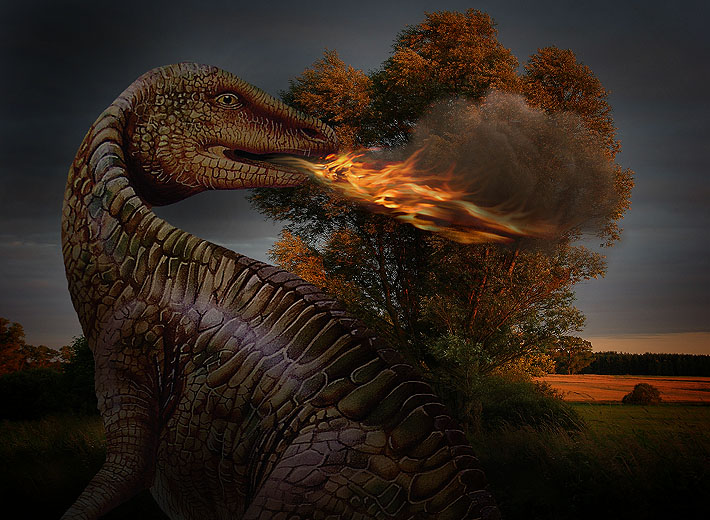
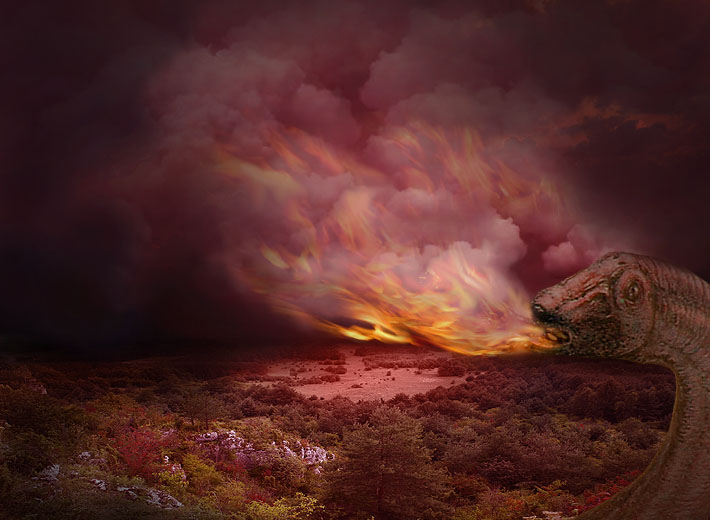
 Could dinosaurs breathe fire like the Wawel Dragon? Why are they associated with dragons? Could dinosaurs breathe fire like the Wawel Dragon? Why are they associated with dragons?
Certainly, Dr. Jacek Piotr's new discoveries support this unpopular hypothesis. It's a well-known fact that digestion produces intestinal gases. Along with ingested food, air also enters the digestive system, reacting to create a mixture of gases in the intestines, dominated by carbon dioxide, hydrogen sulfide, and highly flammable methane. Fermentative processes caused by symbiotic bacteria contribute to this. The largest amounts of intestinal gases accumulate in the colon. Most intestinal gases are absorbed by the bloodstream, but due to the low activity of dinosaurs, the absorption of gases through the blood was reduced to a minimum. The resting phase favored the accumulation of gases, which had to find an outlet from the body through the upper parts of the digestive system. The anatomical structure of dinosaurs facilitated this phenomenon. Significantly larger amounts of gases were produced in the largest herbivorous dinosaurs. Their diet caused dehydration. Dinosaurs, lying lazily basking in the sun, had dry mouths, their teeth were almost completely dry. Thus, when gases, especially methane, escaped through the mouth and came into contact with the dried, massive teeth that could strike sparks with the immense force of the jaws, the highly flammable mixture of intestinal gases ignited. Thus, from the mouths of dinosaurs, larger or smaller tongues of fire occasionally burst forth. |
 Herbivores are more dangerous to
environment!
Herbivores are more dangerous to
environment!